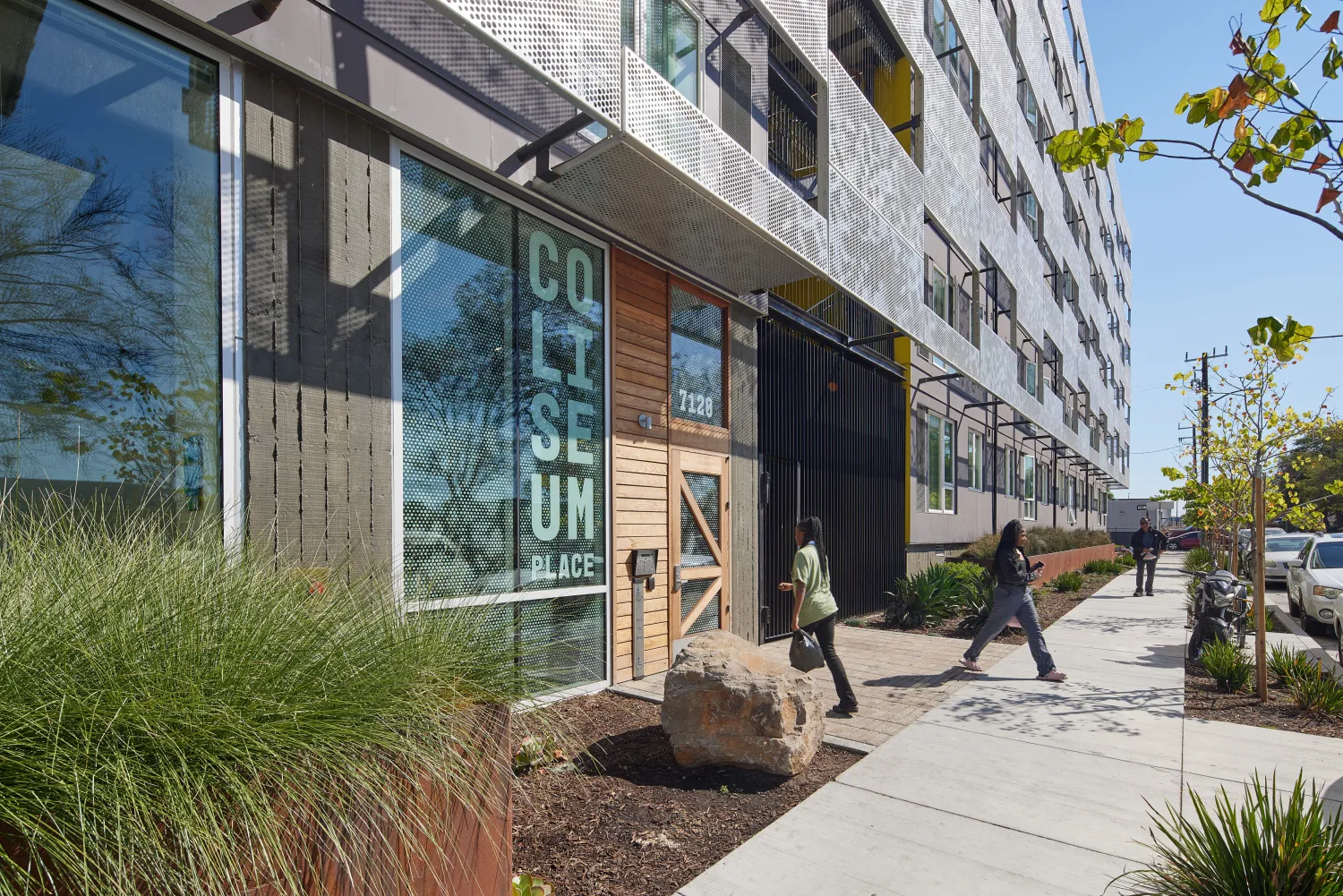
Coliseum Place in Oakland was recognized with a 2025 AIA COTE Top Ten award.
Find the full article here.
UL10: Small-Scale Infill Projects Add Density to Tight Sites
Discover 10 innovative infill projects—from mass timber towers to shipping container apartments—proving that small-scale development can solve big urban challenges.
Small-scale infill development can be a powerful tool for urban revitalization by replacing deteriorating structures and vacant lots. By repurposing constrained, sometimes irregular footprints and respecting neighboring buildings, these interventions capitalize on existing infrastructure and bring fresh energy to established neighborhoods.
The following 10 projects include a fossil-fuel-free apartment building that shares light wells with its neighbor, industrial workspace with five cantilevered floors, multifamily buildings that rise from sites formerly occupied by a single-family dwelling, and apartments in shipping containers stacked on a former traffic median.
1. The Canopy
Detroit, Michigan
In Detroit’s Core City neighborhood, local developer Prince Concepts turned a once vacant lot into a garden community. The first of two phases, completed on a 17,000 square foot (1,580 sq m) lot in 2024, consists of five for-rent duplexes ranging from studios to one- and two-bedroom units. Los Angeles–based design architect EC3, with executive architect Studio Detroit, gave the stucco-clad buildings a variety of sizes and shapes and loosely organized them around several landscaped outdoor “living rooms.”
The developer, which also served as landscape architect, planted 121 trees and added 10,000 square feet of native gardens. Small balconies front the main circulation spine that is to serve both phases. All units have terraces or porches. Expansive glazing frames views of the trees. Parking spots are offsite. Local artist Victor Reyes painted vibrant blue murals on the rooftops. The second phase, under construction, will add seven duplexes to the parcel next door.
2. Charlton WorkStack
London, United Kingdom
Repurposing industrial land for residential use helps alleviate the housing crunch, but it also risks pushing light manufacturers far from a city’s center. The Greenwich Enterprise Board, a not-for-profit provider of affordable workspace, set out to create a new model for high-density industrial facilities on compact sites. On a 15,349 square foot (1,426 sq m) lot in London’s Charlton Riverside industrial area, the five-story Charlton WorkStack makes efficient use of space by cantilevering each floor above the one below. This strategy shelters the delivery area from the elements and affords solar shading. A freight elevator services all floors.
The local studio of dRMM exposed the loadbearing cross-laminated timber walls and ceilings throughout, making additional interior finishes unnecessary. Corrugated steel clads the exterior; windows bring in daylight and natural ventilation. Completed in 2022, the 14 units provide workspace for as many as 60 people. Tenants include furniture makers, clothing manufacturers, and a bicycle/motorcycle workshop.
3. Citizens House
London, United Kingdom
To address the lack of affordable housing in the area, a grass-roots campaign spearheaded by the Lewisham Citizens alliance led to the creation of 11 permanently affordable units on a 0.26 acre (0.11 ha) site formerly occupied by parking garages. London Community Land Trust and Lewisham Citizens worked with the Lewisham Council and the Greater London Authority to carry out the vision. Local architecture firm Archio drew insights from early co-design workshops with the community to shape the layout of the three-to-four-story building and its hardscaped piazza, which serves as a social hub.
Staggered across the façade are projecting balconies that overlook the piazza and promote interaction. Completed in 2023, the homes range from two to three bedrooms. They were sold for 65 percent of open market value. When owners resell, they must do so at rates tied to local earnings. A rooftop 12.7 kWp photovoltaic solar array helps reduce residents’ electricity bills.
4. Coliseum Place
Oakland, California
In the historically underserved neighborhood of East Oakland, a 0.47 acre (0.19 ha) parcel of formerly industrial land presented an unsafe, unsightly impediment between a residential neighborhood on one side and the Coliseum Bay Area Rapid Transit station on the other. Resources for Community Development, a nonprofit affordable housing provider based in Berkeley, brought in the San Francisco office of David Baker Architects to design Coliseum Place as a replacement. The six-story structure combines 59 apartments, green space, and on-site social services for low-income and formerly unhoused families.
A part of the International Living Future Institute’s Living Building Challenge Affordable Housing Project, the building has an all-electric design and a decentralized heat pump system for hot water. A 98 kW photovoltaic array supplies 100 percent of common loads. Courtyards offer much-needed green space. The façade’s leaf-inspired perforated metal screen filters daylight and mitigates heat gain. Completed in 2022, Coliseum Place also includes a community room and bicycle storage.
5. El Borinquen Residence
Bronx, New York
On a narrow, previously vacant strip of land—195 feet long and 100 feet wide (59 m by 30 m)—the colorful façade of El Borinquen Residence reflects the affordable multifamily building’s dedication to art and its Latinx roots. The 10-story building holds 90 units for young people and individuals who have experienced homelessness; 58 are affordable units for seniors and low-income residents. In designing the building for Comunilife, a local nonprofit organization dedicated to helping Latinx New Yorkers in need, Alexander Gorlin Architects of New York clad the exterior with metal panels in the hues of South American flags.
Comunilife provides on-site social services and sponsors activities to build community. Storefront windows give passersby glimpses into the gallery space, which hosts rotating exhibitions of work by local artists and serves as a hub for area residents. The building runs on 90 percent electric power. Enhanced insulation helps minimize energy use.
6. Isla Intersections
Los Angeles, California
To increase the affordable housing stock, Los Angeles made leftover slices of city-owned land available to affordable housing developers. These parcels included a 19,814 square foot (1,841 sq m) wedge-shaped median alongside the interchange of the 110 and 105 freeways. Nonprofit developer Holos Communities of North Hollywood worked with the local office of Lorcan O’Herlihy Architects to turn shipping containers into 54 units for people who have experienced homelessness. Completed in 2024, 16 box-shaped towers, each consisting of three containers welded together, are stacked at varying angles to their neighbors, thus protecting the interior courtyard from traffic noise.
The building’s volume steps down from five stories to two near the single-family neighborhood across the street. Exterior walkways at each level connect the stacked boxes to one another, with small green spaces tucked between towers. Alongside the site’s western edge runs a new paseo, its trees and shrubs chosen for their capacity to filter air pollutants. The use of modular construction shaved 15 months off the construction time.
7. Julia West House
Portland, Oregon
For three decades, the First Presbyterian Church of Portland offered community programs out of a single-family home in downtown. In 2018, the church sold the more-than-125-year-old structure to the local office of Community Development Partners to build 90 studio and one-bedroom units of permanent supportive housing. Tenants are elders and Black, Indigenous, and other individuals of color who are exiting homelessness and earning 30 percent or less of the area median income. The 12-story building occupies a site just 50 by 100 feet (17 by 3 m) in size and is the state’s tallest mass timber edifice.
Amenities include a community room, a communal kitchen, laundry facilities, and secure bicycle parking. A ground-floor canopy, a roof-deck overhang, and recessed windows provide shade. Designed by the local office of Holst Architecture, the Julia West House—named after the wife of the First Presbyterian Church’s initial pastor—opened in 2025.
8. One Sullivan Place
New York, New York
In designing this 52-unit apartment building on a narrow, once-vacant corner site—40 feet wide by 100 feet long (12 m by 30 m)—local firm RKTB Architects worked closely with developer Sterling Town Equities to maximize the buildable floor area. The solution: cantilever a portion of the 12-story structure over the neighboring six-story apartment building, also owned by Sterling Town Equities. A two-story Warren Steel truss supports the 11th and 12th stories, extending them beyond the property line.
Among the last projects to qualify for New York City’s Privately Financed Affordable Senior Housing program, One Sullivan Place includes 16 units designated as affordable, of which 14 are earmarked for senior residents. A floor area bonus enabled the provision of housing for seniors. Expansive glazing provides views of the Brooklyn Botanic Garden, across the street, as well as of the Manhattan skyline. Metal panels and red brick harmonize with the exteriors of surrounding buildings.
9. ParkLife
Brunswick, Victoria, Australia
Not-for-profit organization Nightingale Housing of Brunswick, Victoria, has been teaming with local architecture firms to create a community, dubbed The Village, on a site formerly given over to warehouses. Nightingale supported Austin Maynard Architects, headquartered in Carlton, Victoria, in serving as developer and designer of ParkLife. The all-electric, fossil-fuel-free apartment building, which encompasses 37 homes and two for-rent commercial spaces, occupies a 0.17 acre (0.07 ha) site facing Bulleke-Bek Park.
The site abuts another residential building to the east; by sharing light wells, the two buildings benefit from increased daylight. On hot days, misters in the lightwells cool air before it enters the units. With energy recovery ventilation and a highly insulated building envelope, the structure needs no mechanical heating or cooling. Completed in 2022, ParkLife offers residents plenty of communal areas, including a garden, a shared laundry facility, an outdoor dining area, and a rooftop amphitheater.
10. Ulster House
Toronto, Ontario, Canada
Billed as Toronto’s first multiplex condominium, the five-unit Ulster House replaces a decaying two-story single-family home and garage with a three-story volume and adjacent laneway suite. Created by Janna Levitt and Dean Goodman, principals of local firm LGA Architectural Partners, the complex responds sensitively to its context; its terra cotta tile cladding nods to the brick cladding of some neighboring Victorian houses, and its sloping form echoes the pitch of nearby roofs. Landscaping includes native plantings and a legacy blue spruce.
The ground-floor unit connects to the laneway suite via a covered walkway. Levitt and Goodman currently occupy both, though these units can be configured independently. Two two-story, two-bedroom units occupy the second and third floors, each unit with its own terraces. The fifth unit is tucked into the basement. Completed in 2025, Ulster House runs its all-electric heating, ventilation, and cooling system with the help of rooftop photovoltaic panels.
Ron Nyren is a freelance architecture, urban planning, and real estate writer based in the San Francisco Bay area.
Find the full article here.
Learn more about Coliseum Place here.