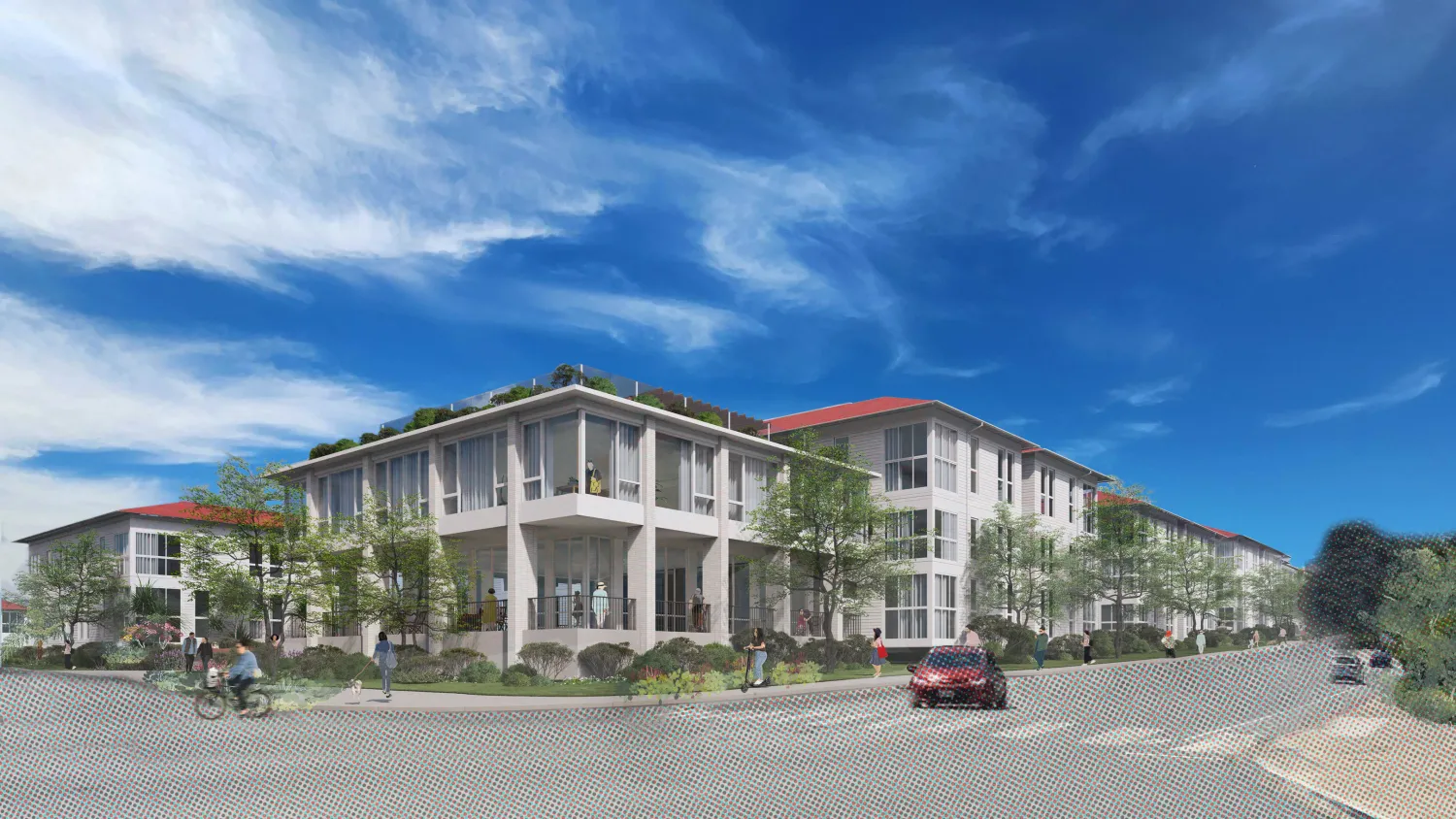
The project will bring 196 rental apartments to The Presidio.
View the full article: S.F.’s Presidio plans first new housing in 20 years with 196-unit apartment project, which appeared in the San Francisco Chronicle on October 30, 2025.
San Francisco’s historic Presidio will get its first new ground-up development in more than two decades, with a 196-unit, six-building apartment complex planned on 4.6 acres of the 60-acre district once occupied by the Army’s Letterman General Hospital.
The project represents a major effort by the Presidio to generate the revenue needed to keep the federal entity self-sufficient and create more housing in a one-of-a-kind national park that has 1,400 housing units that are more than 97% percent occupied. The housing at the Presidio currently brings in about 35% of the revenue needed to operate the park, according to Joshua Bagley, deputy chief business officer for the Presidio Trust.
Adding another 196 market-rate units will increase that revenue stream in a significant manner, he said.
“If people love the Presidio, they will love this project because it will add more housing, repair a key historic district and generate the revenue necessary to meet our park goals of delivering a beautiful, safe and clean park with no entrance fees, forever,” Bagley said.
The project comes at a time when the vast majority of market-rate housing in San Francisco is stalled because of high construction costs and the lack of equity capital willing to invest in the city. The Presidio is unique because the former Army base that connects to the Golden Gate Bridge can borrow from the U.S. Treasury, which will finance the development along with Presidio Trust equity. Bagley said it’s unclear what the project will cost. It will likely break ground in 2027.
While the Presidio is home to 3,000 residents, it lacks smaller units, Bagley said. About 75% of the apartments in the Presidio have at least three bedrooms, with some boasting five or six bedrooms. The new building will be comprised of mostly studios and one- and two-bedroom units.
“We think it will give us an opportunity to diversify the portfolio with more housing, and we think it will create a more inviting park experience while helping to restore a key historic district in the Presidio that is not quite in the same condition as other parts of the Presidio,” Bagley said.
On Monday the Presidio Trust will publish a “notice of intent” to begin the environmental review process for the development. A public meeting will be held Nov. 18.
The proposed development calls for the construction of six low-scale buildings at the intersection of Lincoln Boulevard and Girard Road on land currently occupied by a parking lot and two non-historic structures. One of the buildings is vacant, and the other is being used by U.S. Park Police for storing evidence.
By adding about 160,000 square feet of new buildings, the trust is hoping to restore the look and feel of the Army’s old Letterman General Hospital, which was built in 1898. The complex was, at one point, the densest part of the military base, with long and narrow buildings.
The new buildings will be two and three stories tall and designed to be compatible with the park’s historic structures — wooden walk-ups with peaked roofs and the Presidio’s signature white and gray lap siding — without mimicking the aesthetic, according to Daniel Simons, a partner with David Baker Architects, which is working with Presidio Trust on the development.
Simons said designing a new residential campus for the Presidio is different than doing a project anywhere in San Francisco because, rather than a mishmash of different architectural motifs, the park has a consistent vernacular of color and building type that is at once elegant and utilitarian.
“With a lot of those buildings, they were not thinking about designing architectural masterpieces,” he said. “They were very utilitarian buildings. They were very simple. They were straightforward. They used simple materials. They weren’t fussy. They served a purpose. That was something we found inspiring.”
The plans call for the buildings to be “compatible in design to the architecture found in the Presidio’s Letterman District, reestablishing the character and layout of this historic area.” The two buildings slated to be removed were constructed in the mid-1970s.
Simons said the complex would focus on “a strong connection to the out-of-doors,” adding to the Presidio’s “meandering paths and moments of discovery.” Several of the buildings would be walk-ups with exterior stairs leading to second-story homes.
“We wanted to find ways to replicate that so it didn’t feel like there was one way to move through this campus,” he said.
The project is the Presidio’s most ambitious ground-up development since the Letterman Digital Arts Center opened in 2005. Since then the park has welcomed a series of restorations of historic structures, including the Disney Family Museum, which opened in 2009; the Presidio Landmark, an apartment complex opened in 2010; and the Inn at the Presidio, which debuted in 2012.
Bagley said this project would be different than previous Presidio projects because the trust is developing it alone, rather than with an outside partner.
“This will be the first opportunity for the Presidio Trust to be the developer on a new construction site,” Bagley said. “We have enjoyed, for years, partnering with the private sector, but this is an opportunity for the Presidio Trust to make a significant investment in the park. While we will take all the development risk, that means we will also be rewarded with all the upside.”
The need for the Presidio to strengthen its balance sheet became more pronounced in February when President Donald Trump issued an executive order to eliminate the Presidio Trust, the federal agency that manages San Francisco’s Presidio National Park. The trust has pushed back against the attack on its independence, defending its status as a self-sufficient, financially sound model.
“It’s really, really important we maximize the real estate to the best extent we can,” said Bagley, adding that the project “will be a significant boost to our revenue.”
The conceptual plan for ground-up resident development on the site has its roots in two Presidio plans, one from 2000 and one from 2007, which called for the “removal and replacement of non-historic housing in previously developed areas west of the historic complex, to provide more compatible residential structures close to work sites.”
“These proposed changes would enhance the historic setting and reinforce the coherent, pedestrian-oriented character of the complex,” the plan stated.