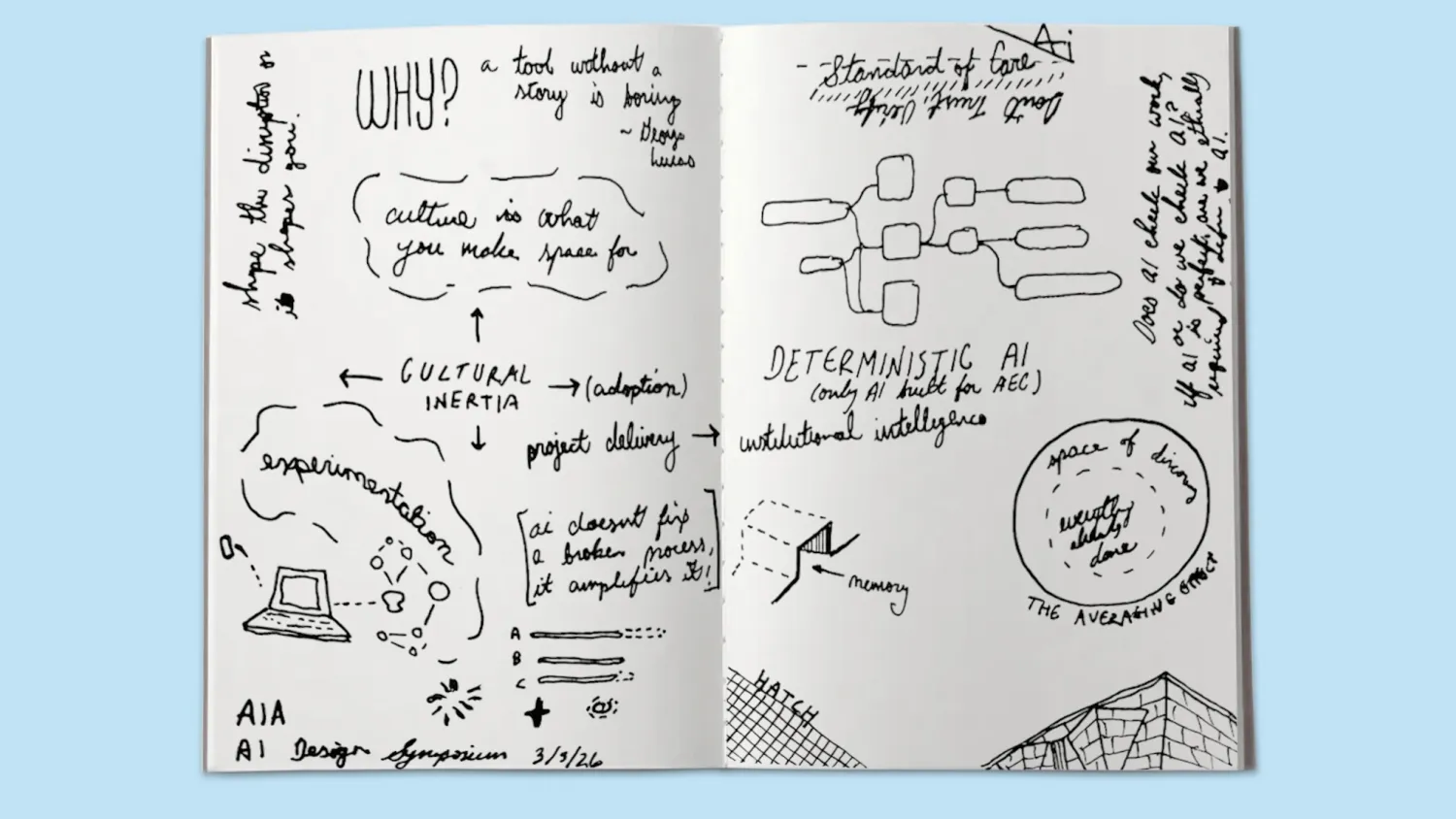
Reflections and musings from the AIA San Francisco AI Design Symposium, March 2026
Architecture has always been downstream of technology. Blueprints ceded to CAD (computer-aided design) and now BIM (building information modeling). We adapt, absorb, move on. But something about this moment—as AI is changing the practice of architecture—feels different. We've been moving toward it for 70 years, and I think it’s worth trying to articulate what this change might mean.
I spent a day at the recent AIA San Francisco AI Design Symposium, surrounded by architects and technologists grappling with what AI means for the profession. The conversation was serious and substantive. It was also, in places, incomplete. And the gaps were as interesting as the content.
The most grounding idea of the day was the shift from project delivery to institutional intelligence. Most firms run on a simple loop: execute, archive, repeat. AI changes that. Used well, AI converts institutional memory into an accessible infrastructure. This is where deterministic AI becomes essential: not the generative tools that produce images from prompts, but systems purpose-built for the built environment community that return consistent, auditable outputs from structured inputs. Tools that help coordinate across disciplines, track decisions, and flag issues before they become problems. The most durable value in the industry is likely built in the areas that are precise and unglamorous. At David Baker Architects, where design is understood as a multiplier of good and every decision carries a responsibility to the community it serves, that accumulated knowledge isn't a nice-to-have. It's how the work gets better over time.
The democratization argument is the one I find most personally compelling. AI compresses the gap between junior designer and senior architect—not by replacing judgment, but by distributing fluency. The designer can spend less time learning mechanics and more time learning to think like an architect. The principal can stay closer to the ideas. For a profession that has always asked people to sacrifice years at the altar of expertise, that shift feels significant.
But here’s what I kept turning over on the way home: The day was long on strategy and short on design. What I find missing from most AI conversations in architecture is a reckoning with what we’re actually optimizing for. There’s a difference between a closed system that predicts and controls and an open one, which cultivates conditions for something unexpected to emerge. The best architecture lives in the second category. It makes room. It invites interpretation rather than foreclosing it. Most of what AI currently does pulls in the opposite direction.
That's the risk, what's being called the averaging effect in AI design circles. A model trained on everything ever built gravitates toward the median, the safe, the already-done. That tendency didn't start with AI. The optimization for efficiency that defined the last half century of building already hollowed out much of the imagination that makes cities feel alive. AI inherits that problem and amplifies it. What produces resilience in ecosystems, cities, or cultures is diversity, specificity, and bottom-up intelligence that responds to local conditions rather than aggregate ones. The question isn't whether to use this technology: It's whether we can use it in a way that strengthens our capacity to adapt, rather than optimizing that capacity away.
At DBA, the commitment has always been to people—people raising families, building lives, aging with dignity. AI can help us serve those people better, but it can’t replace judgement, the care, or the decades of trust that make the work possible. Knowing the difference is the point. The same tools that risk flattening design can, held with intention, free us to do the work that only humans can do—the attentive, the specific, the intimately responsive. The purpose hasn’t changed, connecting people to the world they inhabit, one specific place at a time, but what’s changing is what we’re capable of bringing to that work.
The deeper question is what a new aesthetic looks like on the other side of this shift—not a style, but a sensibility that emerges from the specific, the local, the accumulated. That’s the critical conversation we’re having now at DBA and with others in the profession and beyond.
Jonny Rohrbaugh, AIA, CPHC, is an Associate and DBA's AI Practice Lead. He is based in our San Francisco studio.